
Artemis II
Quick facts
- NASA reports Artemis II launched on April 1, 2026, at 6:35 p.m. EDT from Launch Complex 39B, Kennedy Space Center.[1]
- Crew: Reid Wiseman, Victor Glover, Christina Koch, and CSA astronaut Jeremy Hansen.[2]
- Mission profile: roughly 10-day crewed lunar flyby and return using a free-return trajectory.[2]
- NASA published dated mission-event coverage for launch, translunar operations, and lunar flyby windows.[3]
"Hello, World" paired images (about 19 seconds apart)
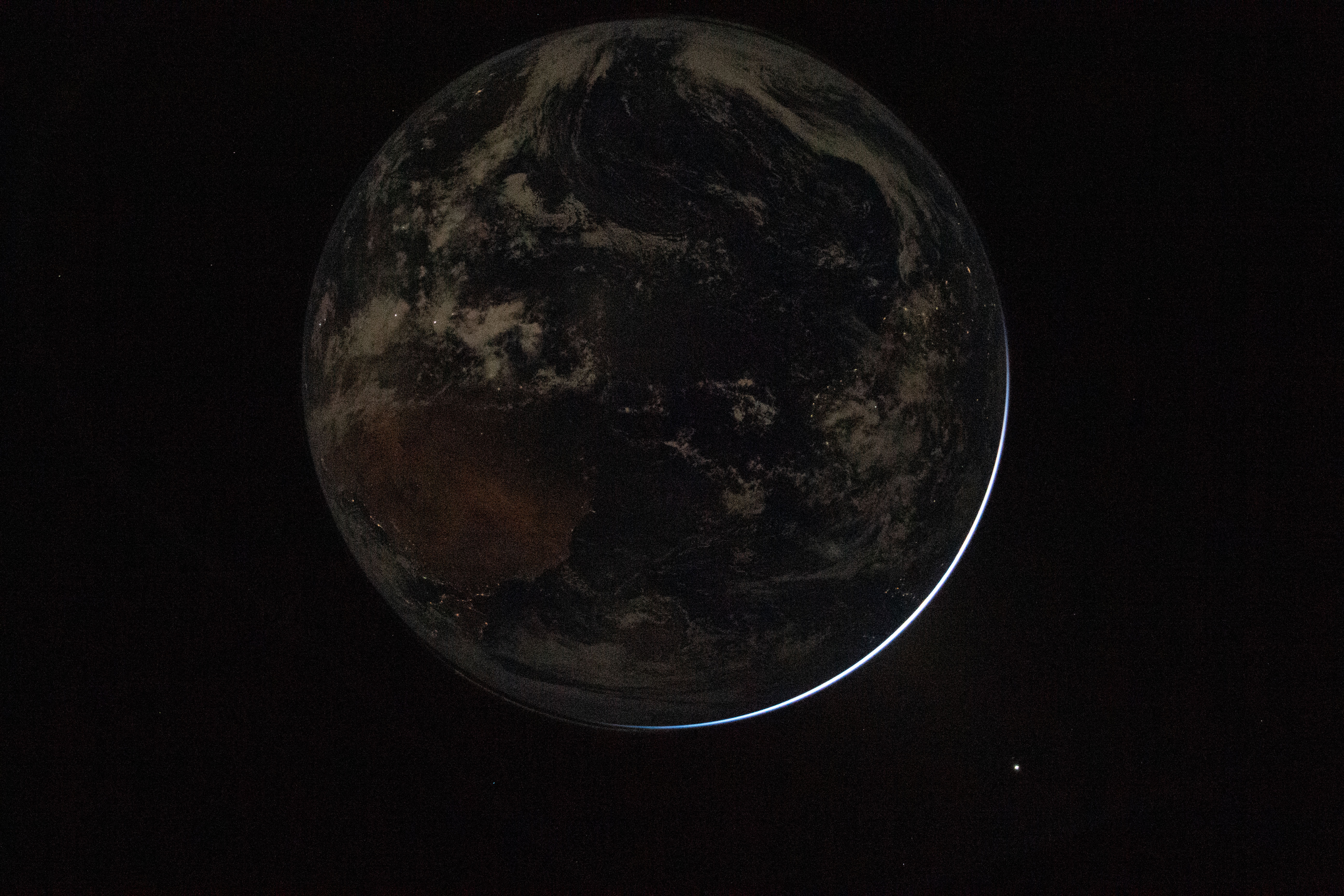
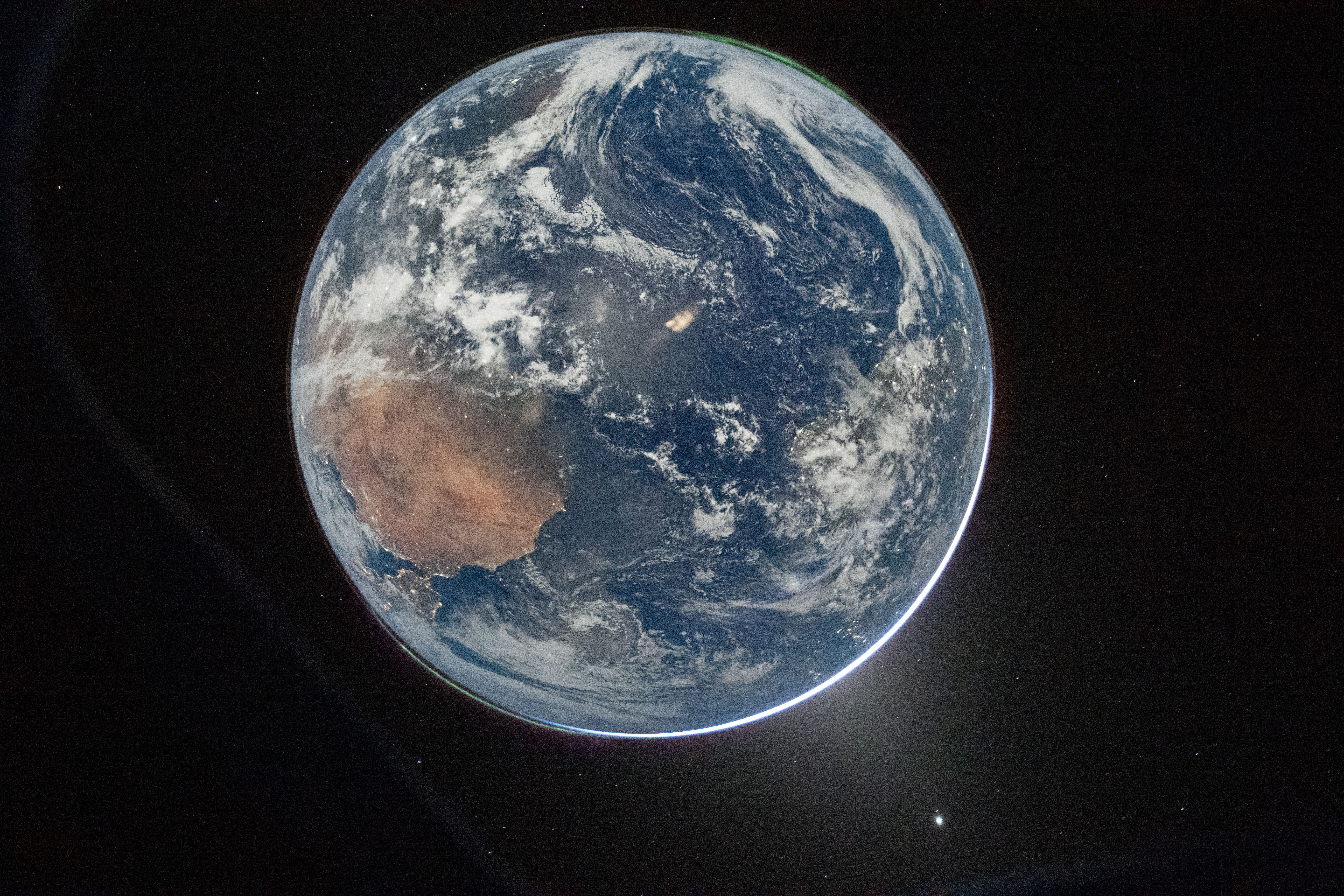
NASA released two Earth photos taken seconds apart with different camera settings (one emphasizes the night side, the other is the widely shared "Hello, World" view). The mission article and gallery pages below are the primary web entry points.
NASA web pages
- Hello, World (image article)
- Hello, World (large presentation image page)
- art002e000193 (backlit Earth, first in time)
- Earth From the Perspective of Artemis II (art002e000192, the "Hello, World" release asset)
- Journey to the Moon gallery (lists both assets among mission imagery)
Source files and EXIF metadata (originals + JSON)
| Asset ID | NASA Images catalog | Original JPG | Machine-readable metadata |
|---|---|---|---|
| art002e000193 | images.nasa.gov | orig | metadata.json |
| art002e000192 | images.nasa.gov | orig | metadata.json |
Capture times in UTC (from EXIF, with subseconds)
These times come from EXIF:DateTimeOriginal plus subsecond fields in NASA's metadata.json / ExifTool output on the ~orig.jpg files.
- art002e000193 (first exposure): 2026-04-03 00:27:20.82 UTC
- art002e000192 ("Hello, World" / Earth From the Perspective): 2026-04-03 00:27:39.26 UTC
- Elapsed time between captures: 18.44 seconds (same pair NASA describes as seconds apart with different settings)
Time zone note (camera vs file processing)
Classic EXIF stores DateTimeOriginal without a time-zone suffix. These files also include EXIF:OffsetTime of -05:00 on some tags, while EXIF:OffsetTimeOriginal is absent. That pattern commonly reflects ground processing workstation timestamps, not a reliable claim that the camera shutter clock was set to UTC−5.
For public mission timing, NASA's release context for this milestone aligns with reporting the capture instant in UTC as listed above (also consistent with subsecond ordering of the pair).
Distance from Earth (NASA primary sources; not in JPEG EXIF)
NASA does not embed range to Earth in the public JPEG EXIF for these assets. The camera EXIF times above are interpreted in UTC for mission discussion (see time-zone note). Distance must come from mission trajectory reporting and tracking products.
- Mission context (after translunar injection): NASA's Hello, World article states the photo was taken from Orion's window after completing the translunar injection burn, on the outbound journey toward the Moon.
- Before TLI (not the photo instant): NASA's April 2 news release says Orion was placed into a high Earth orbit extending about 46,000 miles above Earth for checkouts before the translunar injection burn.
- Overall outbound geometry: NASA's Artemis II press kit describes the post-TLI outbound path as tracing a figure eight that will extend more than 230,000 miles from Earth before returning home (maximum extent along the trajectory, not tied to a single photo time).
- Around Flight Day 3 (qualitative): NASA's Flight Day 3 update states the mission was more than halfway to the Moon while the crew prepared for the flyby.
- Bracketing anchor (later along the same leg): NASA's Flight Day 4 update reports that at crew wakeup on Flight Day 4, Orion was approximately 169,000 miles from Earth (and about 110,700 miles from the Moon). The Hello World pair was taken on 2026-04-03 ~00:27 UTC, about one Earth-day earlier on the outbound leg, so this is a later distance anchor: the spacecraft was farther from Earth at that April 4 wakeup than at the April 03 ~00:27 UTC exposures, but still well beyond the pre-TLI high-Earth-orbit phase described in the news release.
- Where to read off exact miles for a given UTC time: NASA's tracking article and Artemis Real-time Orbit Website (AROW) provide distance from Earth from mission state data (not from the photo files).
- Pair note: The two frames are 19 seconds apart; for distance-to-Earth purposes they are the same position to practical precision.
Why this mission matters for evidence discussions
1) It is not a single-organization story
Artemis II includes international participation (CSA crew member) and partner hardware programs documented in mission material.[2]
2) It has public, time-stamped operations
NASA published expected mission windows, event timings, and regular updates, including phases where communications are expected to drop behind the Moon and then return.[3]
3) It uses a testable trajectory model
The mission design is a free-return path in the Earth-Moon gravity system, which is an established, checkable orbital approach rather than an arbitrary claim.[2]
Mission timeline (primary-source snapshot)
April 1, 2026 (Launch Day)


- Liftoff reported at 6:35 p.m. EDT.[1]
- Core-stage cutoff/separation and Orion solar array deployment reported in mission updates.[1]
April 2, 2026
- NASA reported perigee-raise burn completion and translunar injection preparation.[4]
April 6, 2026 (lunar flyby day in NASA schedule)
- NASA published flyby coverage windows, including lunar sphere-of-influence milestones and expected far-side communications loss/reacquisition periods.[3]
Imagery with source provenance
-
 Launch image with source page: NASA.
 -
 Crew walkout image with source page: NASA.
 -
 Orion in-flight selfie with source page: NASA.
 -
 Crescent Earth image with source page: NASA.


Sources
- ↑ 1.0 1.1 1.2 https://www.nasa.gov/blogs/missions/2026/04/01/live-artemis-ii-launch-day-updates/
- ↑ 2.0 2.1 2.2 2.3 https://www.nasa.gov/artemis-ii-press-kit/
- ↑ 3.0 3.1 3.2 https://www.nasa.gov/missions/artemis/artemis-2/nasa-sets-coverage-for-artemis-ii-moon-mission/
- ↑ https://www.nasa.gov/blogs/missions/2026/04/02/artemis-ii-flight-update-perigee-raise-burn-complete/