Apollo lunar boots: Difference between revisions
Shorter floats so the paragraphs wrap the pictures |
Flight-film frames: March to the Moon primary, NASA secondary |
||
| Line 10: | Line 10: | ||
== What walked on the Moon == | == What walked on the Moon == | ||
[[File:Apollo11 bootprint AS11-40-5877.jpg|right|frame|Buzz Aldrin's bootprint, pressed once into undisturbed soil for the soil-mechanics sequence. The bars are the overboot ribs. | [[File:Apollo11 bootprint AS11-40-5877.jpg|right|frame|Buzz Aldrin's bootprint, pressed once into undisturbed soil for the soil-mechanics sequence. The bars are the overboot ribs. AS11-40-5877, flight film on March to the Moon.]] | ||
The footprint in the comparison is usually [https:// | The footprint in the comparison is usually [https://tothemoon.ser.asu.edu/gallery/apollo/11/7#AS11-40-5877 AS11-40-5877] on Arizona State's [https://tothemoon.ser.asu.edu/ March to the Moon] archive, a scan of the flight film with the sprocket holes still on it. NASA's copy of the same frame is [https://images.nasa.gov/details/as11-40-5877 here]. It is a 70 mm frame from magazine 40, taken on 20 July 1969 during the Apollo 11 moonwalk. Aldrin chose a patch of undisturbed ground, photographed it, stepped once, and photographed the print. The stereo partner is [https://tothemoon.ser.asu.edu/gallery/apollo/11/7#AS11-40-5878 AS11-40-5878], on the same magazine. He did this about an hour after Armstrong's first step, so the soil-mechanics team could see how the surface took a man's weight. Armstrong did not photograph that first step, and the traffic around the forward footpad wiped it out.<ref name="alsjprint">Patrick Vantuyne anaglyph and Eric M. Jones, [https://www.nasa.gov/wp-content/uploads/static/history/alsj/a11/PV-ApAn-40-5877-78.html AS11-40-5877-78], Apollo Lunar Surface Journal. Aldrin's soil-mechanics print, about an hour after Armstrong stepped off the ladder.</ref><ref name="clavius">Jay Windley, [https://www.clavius.org/footprnt.html ''Photo Analysis: footprint''], Clavius.</ref> The Apollo 11 Preliminary Science Report uses the frame for the bearing strength of the soil, and for the crust that cracked and bulged around the print.<ref name="sp214">NASA, ''Apollo 11 Preliminary Science Report'', SP-214 (1969). The Hasselblad frame is captioned as the astronaut's bootprint, made so the bearing strength could be studied later. Discussed on the [https://www.nasa.gov/wp-content/uploads/static/history/alsj/a11/PV-ApAn-40-5877-78.html Journal anaglyph page].</ref> | ||
[[File:Apollo11 overboot and print AS11-40-5880.jpg|left|frame|The overboot on the Moon, and the ribs it has just pressed into the soil. The white suit leg enters the top of the outer boot. | [[File:Apollo11 overboot and print AS11-40-5880.jpg|left|frame|The overboot on the Moon, and the ribs it has just pressed into the soil. The white suit leg enters the top of the outer boot. AS11-40-5880, flight film on March to the Moon.]] | ||
[https://images.nasa.gov/details/as11-40-5880 | [https://tothemoon.ser.asu.edu/gallery/apollo/11/7#AS11-40-5880 AS11-40-5880] on March to the Moon ([https://images.nasa.gov/details/as11-40-5880 NASA copy]), from the same magazine, is the boot and the print in one frame. The white leg of the suit comes down into a separate outer boot. The sole of that boot is a row of horizontal ribs, and the soil beside it holds the same row. That is the tread in AS11-40-5877. The silicone sole was flexible, so it took the shape of the ground under it. Aldrin stepped forward and drew the foot back, and the heel dug a little deeper than the toe.<ref name="clavius" /> | ||
[https://images.nasa.gov/details/as11-40-5868 | [https://tothemoon.ser.asu.edu/gallery/apollo/11/7#AS11-40-5868 AS11-40-5868] on March to the Moon ([https://images.nasa.gov/details/as11-40-5868 NASA copy]) is Aldrin on the ladder a few minutes after he came out of the hatch, already wearing the outer boots. Both feet are in them. The white suit legs disappear into the tops, which is the same boundary as the pre-flight laydown, now closed up for the surface. The ribs are there. They are small in the wide frame. The close-up is 5880. | ||
== Three layers == | == Three layers == | ||
Revision as of 01:57, 12 October 2026
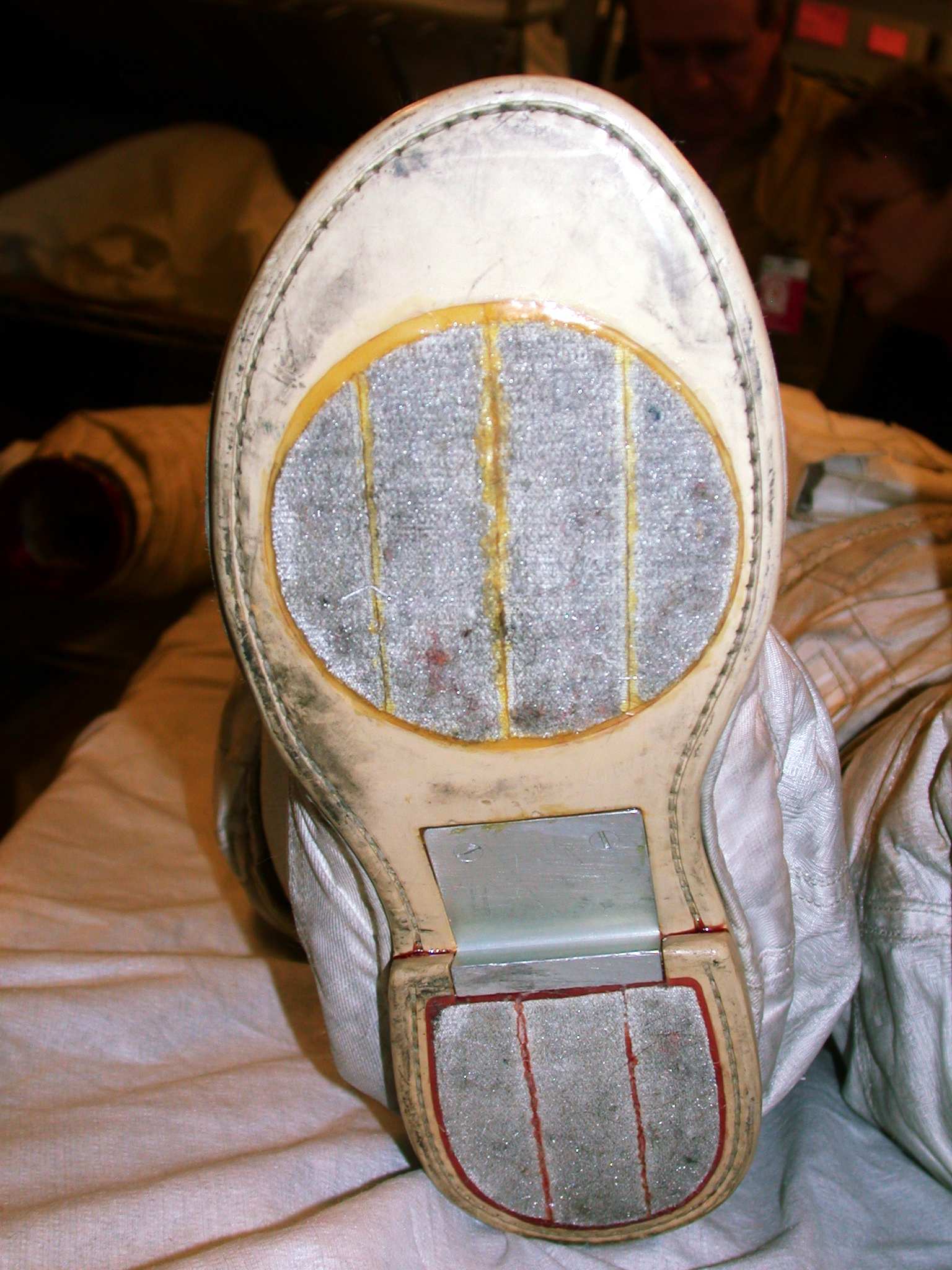
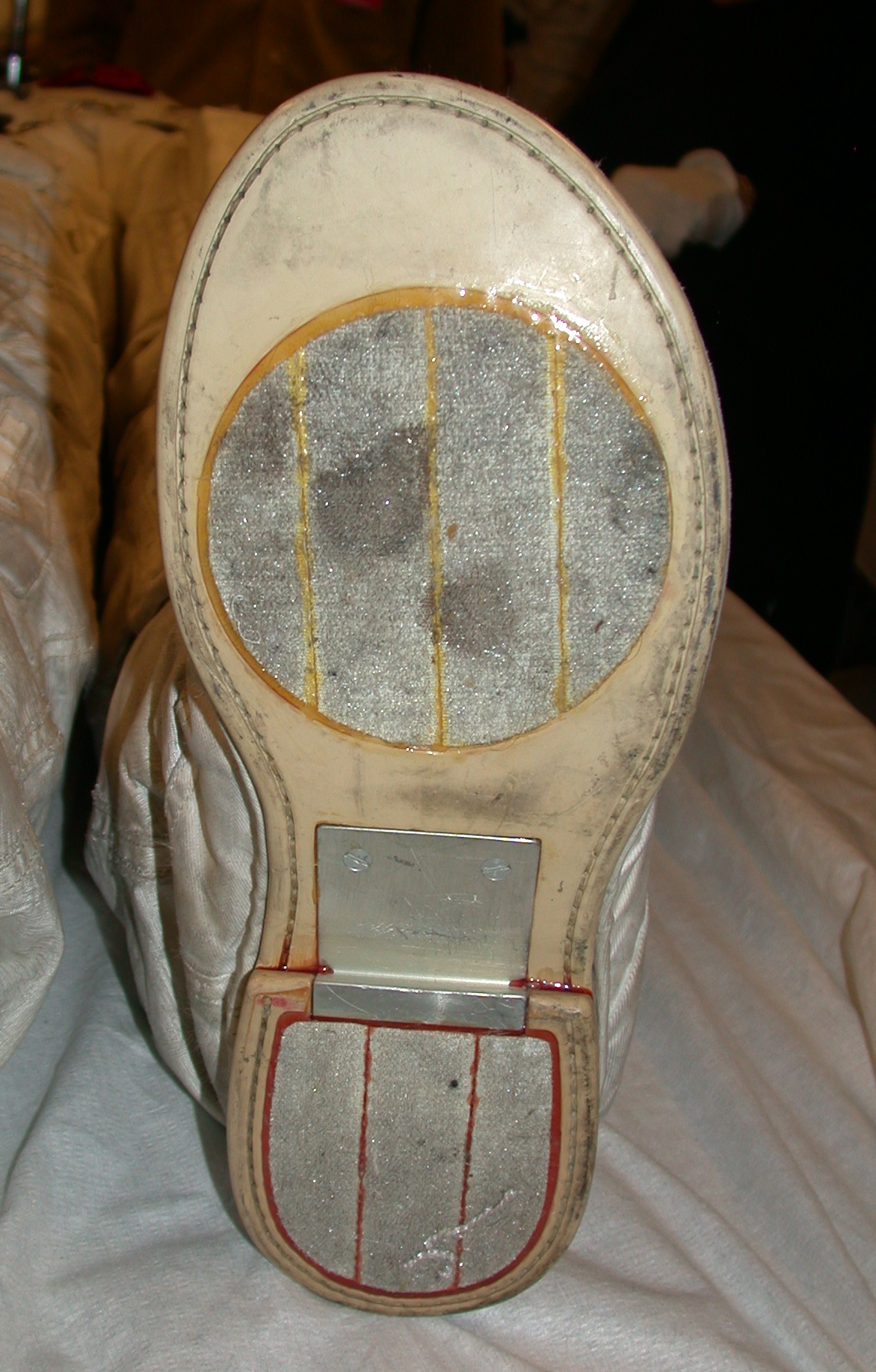
Apollo lunar boots are the footwear that made the footprints on the Moon. The sole still attached to a returned spacesuit is a second boot, worn inside the first. NASA photographed the two together before Apollo 11 flew. The ribbed sole is the outer boot. The shallow sole is the inner one.

The comparison that circulates sets this sole beside a lunar footprint and treats the difference as proof the landing was staged. The footprint is a row of deep horizontal bars. This sole is a flat oval with light stripes and a metal plate at the heel. Both objects are real, and both belong to the same outfit. They were never the same piece of hardware.

NASA photograph S69-38889 is the pre-flight laydown of Armstrong's Apollo 11 commander suit. One integrated boot is turned sole-up. Beside the legs are the lunar overboots, the name ARMSTRONG on the strap, the ribbed soles toward the camera. The card in the frame reads PGA 076. On the flown suit that number is the liner assembly. The pressure garment itself is serial 056. The card was lettered from the liner label by the neck ring.[1]
The Apollo Lunar Surface Journal reproduces S69-38889 as the pre-flight picture of the flown suit. The same page holds April 2006 photographs of both soles as the suit sits now, taken at the museum's Garber facility by Ulrich Lotzmann, Amanda Young, and Bill Ayrey. Those soles match the shallow one in the 1969 laydown. The overboots are gone. The ribs in that laydown are the tread in the print: the same bars, photographed before the crew left Earth.[2]
What walked on the Moon

The footprint in the comparison is usually AS11-40-5877 on Arizona State's March to the Moon archive, a scan of the flight film with the sprocket holes still on it. NASA's copy of the same frame is here. It is a 70 mm frame from magazine 40, taken on 20 July 1969 during the Apollo 11 moonwalk. Aldrin chose a patch of undisturbed ground, photographed it, stepped once, and photographed the print. The stereo partner is AS11-40-5878, on the same magazine. He did this about an hour after Armstrong's first step, so the soil-mechanics team could see how the surface took a man's weight. Armstrong did not photograph that first step, and the traffic around the forward footpad wiped it out.[3][4] The Apollo 11 Preliminary Science Report uses the frame for the bearing strength of the soil, and for the crust that cracked and bulged around the print.[5]

AS11-40-5880 on March to the Moon (NASA copy), from the same magazine, is the boot and the print in one frame. The white leg of the suit comes down into a separate outer boot. The sole of that boot is a row of horizontal ribs, and the soil beside it holds the same row. That is the tread in AS11-40-5877. The silicone sole was flexible, so it took the shape of the ground under it. Aldrin stepped forward and drew the foot back, and the heel dug a little deeper than the toe.[4]
AS11-40-5868 on March to the Moon (NASA copy) is Aldrin on the ladder a few minutes after he came out of the hatch, already wearing the outer boots. Both feet are in them. The white suit legs disappear into the tops, which is the same boundary as the pre-flight laydown, now closed up for the surface. The ribs are there. They are small in the wide frame. The close-up is 5880.
Three layers
The boot people turn over in a museum is itself two assemblies. The moonwalk added a third.
The inner piece is the pressure boot, part of the torso-limb suit. It holds the suit's oxygen. The ankle is a convoluted joint so the foot can flex. Over that sits the integrated thermal micrometeoroid garment. Its boot covers the pressure boot except at the sole and heel, laced and zipped to the leg. A Teflon patch around the ankle kept the outer boot from rubbing the cover. The sole in S69-38889, and the soles on Armstrong's suit at the National Air and Space Museum, are this integrated boot. It was the boot for launch, for the coast, and for entry: the inside of the spacecraft.[6][7][8]

The outer piece is the lunar boot, also called the lunar overboot or the lunar overshoe. The crew donned it in the lunar module before the hatch opened. The astronaut opened a retaining strap and two snaps, slid the suit boot in with a donning strap at the heel, closed the snaps, and latched a strap across the instep. The latch was built to work in the extravehicular gloves.[6]
On the Apollo 11 through 14 suits the outer shell, except the sole and the tongue, is Chromel-R, a woven chromium-steel cloth. The tongue is Teflon-coated Beta cloth. The sole is silicone rubber. Ribs stand off the bottom of that sole to add insulation, to stiffen it sideways, and to give traction. Inside, for those flights, the stack runs from the Chromel-R inward through two layers of Kapton, five layers of aluminized perforated Mylar separated by nonwoven Dacron, a Beta-cloth liner, and Nomex felt in the sole.[6] Apollo 15, 16, and 17 kept the Chromel-R shell and the ribbed silicone sole. The insulation stack inside was changed. The later handbook lists a Beta-cloth liner, aluminized Mylar, Nomex felt, a Kapton laminate, and the same steel cloth and silicone sole.[9][10]
Left on the surface

Apollo 11 through 16 left the overboots on the Moon with the backpacks, before the lunar module lifted off. Armstrong's suit came home with the integrated boots still on it. A photograph of that suit in a gallery is a photograph of the inner boot. The tread in the prints was never on it.[2][8]
Apollo 17 broke the pattern. Eugene Cernan and Harrison Schmitt brought their overshoes back. Cernan later said the choice was his, against the plan for the flight. His pair is on display in Destination Moon at the National Air and Space Museum, transferred from NASA in 1974. The left boot is A19740133005. The right boot is A19740133006. International Latex made them. The sole is silicone. The upper is Chromel-R. Lunar dust is still ground into the cloth and the rubber. Cathleen Lewis, the museum's curator of space history, wrote in 2022 that visitors regularly ask why the prints do not match the soles on Armstrong's suit. Her answer is these overshoes: the integrated boots were for the inside of the spacecraft, and the galoshes were for the surface.[11]
The same outer boot shows up in training. KSC-72PC-0498 is Schmitt brushing Cernan's boot at Kennedy Space Center before they entered a lunar-module mock-up. NASA's caption says the crew would do the same thing on the Moon.
The claim
The pairing has been a standard moon-landing denial image since at least August 2016, when Snopes answered a version that set Armstrong's museum boots against a footprint labeled as his. The footprint in that pairing is Aldrin's, and the museum sole is the integrated boot.[12] PolitiFact answered the same pairing on 7 May 2019, from a Facebook post of 23 April 2019 that put "Neil Armstrongs Space Boots" next to "Neil Armstongs footprint."[13] Reuters has answered the related claim that the boots preserved with the suits are the ones that touched the Moon. On Apollo 11 they were left behind.[14]
A drawing of the overboot, and a longer hardware history, is at heroicrelics.org. The ribs, the Chromel-R, and the way the suit boot slides in are taken there from the same NASA handbooks cited above.
See also
References
- ↑ collectSPACE, Neil Armstrong's Apollo 11 PGA suit number. The liner-assembly serial 076 was read as the suit serial. The flown pressure garment is 056.
- ↑ 2.0 2.1 Eric M. Jones, Neil Armstrong's Flown Suit, Apollo Lunar Surface Journal. NASA photo S69-38889. Sole photographs: right and left. The Journal notes, on a detail of AS11-40-5896, that the EVA boots were jettisoned before liftoff and were not returned.
- ↑ Patrick Vantuyne anaglyph and Eric M. Jones, AS11-40-5877-78, Apollo Lunar Surface Journal. Aldrin's soil-mechanics print, about an hour after Armstrong stepped off the ladder.
- ↑ 4.0 4.1 Jay Windley, Photo Analysis: footprint, Clavius.
- ↑ NASA, Apollo 11 Preliminary Science Report, SP-214 (1969). The Hasselblad frame is captioned as the astronaut's bootprint, made so the bearing strength could be studied later. Discussed on the Journal anaglyph page.
- ↑ 6.0 6.1 6.2 Apollo Operations Handbook, Extravehicular Mobility Unit, Volume 1, CSD-A-789-(1), Apollo 14 (June 1970), NASA TM-X-66478. NTRS 19710001731. Section 2.2.6, Lunar Boots, and Figure 1-30. The integrated-boot paragraph is in the external-cover section just ahead of it: the garment boot covers the pressure boot except the sole and heel, and a Teflon ankle patch stops the lunar boot abrading it.
- ↑ Roy Christoffersen and others, Lunar Dust Effects on Spacesuit Systems: Insights from the Apollo Spacesuits, NASA/TP-2009-214786. PDF. The lunar-surface boot was a third assembly, worn only on the Moon, over the pressure boot and its thermal cover.
- ↑ 8.0 8.1 National Air and Space Museum, Armstrong's spacesuit. The overshoes were worn only on the Moon and were left there, with the backpacks, to save weight on the ascent.
- ↑ Apollo Operations Handbook, Extravehicular Mobility Unit, Volume 1, Apollo 15-17 revision (March 1971), NASA TM-X-69516. NTRS 19730064704. Figure 2-9 and Table 2-VII, materials cross section for the lunar boot.
- ↑ NASA, Biomedical Results of Apollo, SP-368, the extravehicular mobility unit chapter. NTRS 19760005607. Figure 16 is the same lunar-boot drawing.
- ↑ Cathleen Lewis, Overshoes from the Last Man on the Moon, National Air and Space Museum, 12 December 2022.
- ↑ Snopes, Lunar Footprint Mystery, 16 August 2016.
- ↑ Ciara O'Rourke, No, these photos of Neil Armstrong's space boots and a footprint don't disprove the moon landing, PolitiFact, 7 May 2019.
- ↑ Reuters Fact Check, Apollo 11 astronauts left their space boots on the moon.