
File:2026-03-18 TravisEdwards-h1j Two Poles.png: Difference between revisions
On 2026-03-18, TravisEdwards-h1j (suspected to be a sock puppet of DamascusSteel) used <q>Δlat × 111,132 m/° north + Δlon × cos(lat) × 111,132 m/° east</q> as a <q>simpler flat-Earth approximation</q> to calculate a distance on the planet. According to his math, the distance between lines of longitude scales by the cosine of the latitude which is zero at both the North Pole and the South Pole. Therefore, lines of longitude converge at the poles. This describes a globe. |
m Update the wording |
||
| (2 intermediate revisions by the same user not shown) | |||
| Line 1: | Line 1: | ||
== Summary == | == Summary == | ||
On 2026-03-18, TravisEdwards-h1j (suspected to be a sock puppet of DamascusSteel) used <q>Δlat × 111,132 m/° north + Δlon × cos(lat) × 111,132 m/° east</q> as a <q>simpler flat-Earth approximation</q> to calculate a distance on the planet. | On [https://www.youtube.com/watch?v=QN9VEIaNq0o&lc=UgzhMaydpFRREjGjGHt4AaABAg 2026-03-18], TravisEdwards-h1j (suspected to be a sock puppet of [[DamascusSteel]]) used <q>Δlat × 111,132 m/° north + Δlon × cos(lat) × 111,132 m/° east</q> as a <q>simpler flat-Earth approximation</q> to calculate a distance on the planet. | ||
According to his math, the distance between lines of longitude scales by the cosine of the latitude which | According to his math, the distance between lines of longitude scales by the cosine of the latitude which shrinks to zero at both the North Pole and the South Pole. Therefore, lines of longitude converge at the poles. This describes a globe. | ||


Latest revision as of 04:56, 18 March 2026
Summary
On 2026-03-18, TravisEdwards-h1j (suspected to be a sock puppet of DamascusSteel) used Δlat × 111,132 m/° north + Δlon × cos(lat) × 111,132 m/° east
as a simpler flat-Earth approximation
to calculate a distance on the planet.
According to his math, the distance between lines of longitude scales by the cosine of the latitude which shrinks to zero at both the North Pole and the South Pole. Therefore, lines of longitude converge at the poles. This describes a globe.
File history
Click on a date/time to view the file as it appeared at that time.
| Date/Time | Thumbnail | Dimensions | User | Comment | |
|---|---|---|---|---|---|
| current | 04:52, 18 March 2026 | 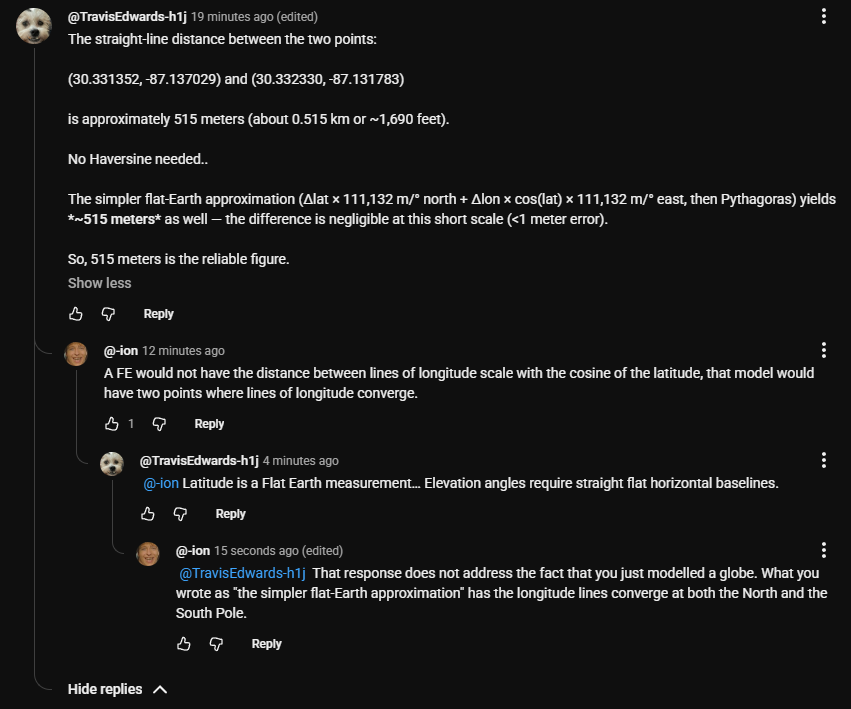 | 851 × 709 (63 KB) | Ion (talk | contribs) | On 2026-03-18, TravisEdwards-h1j (suspected to be a sock puppet of DamascusSteel) used <q>Δlat × 111,132 m/° north + Δlon × cos(lat) × 111,132 m/° east</q> as a <q>simpler flat-Earth approximation</q> to calculate a distance on the planet. According to his math, the distance between lines of longitude scales by the cosine of the latitude which is zero at both the North Pole and the South Pole. Therefore, lines of longitude converge at the poles. This describes a globe. |
You cannot overwrite this file.
File usage
The following page uses this file:
